Computational Algorithms for
Multidimensional Opinion Dynamics
and Structural Evolution in Digital Platforms
Cognitive Resonance, Trust, and the Geometry & Collapse of Opinion Diversity
Outline
- Motivation & the one-dimensional problem
- Research questions & contributions
- Background: networks, opinion dynamics, cognition
- Part I, The PSCR-T framework (cognitive resonance & trust)
- Part II, Spatial opinion models & community detection
- Part III, Detecting & preventing opinion diversity collapse (D-CEWS)
- Part IV, The social-media discourse context
- Conclusions, limitations & future work
Emphasis throughout is on the social-dynamics frameworks (Parts I–III).
Introduction
Why one number is not enough
The central observation
Human opinion is fundamentally multidimensional, yet the dominant mathematical models of opinion dynamics represent it as a single scalar.
- Social media has transformed how people think, share, and develop opinions.
- Studying opinion is no longer purely academic: elections, misinformation, social cohesion.
- This gap has real consequences for what our models can, and cannot, explain.
The classical scalar assumption
Foundational models, DeGroot, Friedkin–Johnsen, bounded confidence, all share one feature:
- Elegant and analytically tractable.
- But a person's stance is a composite: economics, social issues, foreign affairs, environment.
- These dimensions correlate, but are not collapsible without critical information loss.
Empirical pressure to move beyond 1D
- Filter bubbles: algorithmic curation reinforces existing preferences (Sunstein 2017).
- Echo chambers: densely connected clusters suppress cross-cutting information (Cinelli 2021).
- Counter-intuitively, exposure to opposing views can increase polarization (Bail 2018).
- Algorithmic ranking reduces cross-cutting exposure beyond individual choice (Bakshy 2015).
- Decades-long rise in affective polarization, negative partisanship, not policy (Iyengar 2019).
Divergence is multidimensional & asymmetric
Two individuals may agree on economic policy yet hold incompatible views on social identity, environmental regulation, and institutional trust.
- Echo-chamber dynamics operate differently across distinct dimensions.
- Agents can ally on one issue while dividing on another, richer than polarization along one axis.
- To model this, opinions must be vectors in a multidimensional space.
Central research questions
- RQ1 How can psychological mechanisms, cognitive resonance, perceptual salience, personality-based trust, be incorporated into multidimensional opinion dynamics, and what new behaviours emerge?
- RQ2 Can rigorous convergence & stability conditions be established for coupled opinion–trust systems, and what fundamental limits do static influence models face regarding dynamic fragmentation, tipping points, and echo chambers?
- RQ3 How can multidimensional opinion representations drive community detection, and what geometric measures quantify opinion diversity?
Objectives
- Develop the PSCR-T framework with formal convergence analysis and impossibility results.
- Validate it empirically on social networks, with ablation studies.
- Extend multidimensional opinions to community detection via spatial representation.
- Quantify diversity with geometric measures (polyhedron volumes) and modified modularity optimization.
- Develop a causal early-warning detector and a gated intervention that anticipate and prevent tipping points toward consensus collapse.
Contributions at a glance
Part I: PSCR-T
- Salience · resonance · dynamic trust
- Global convergence theorem
- Small-gain local stability
- Impossibility + attenuation theorems
- 4 real multiplex networks
Part II: Geometry
- Opinion polygons & polyhedra
- Opinion Diversity Index \(D(G)\)
- MBR + R-tree indexing
- Opinion-driven Louvain
- WOSN 2009 & Karate Club
Part III: Collapse
- Narrative RL × noisy voter model
- D-CEWS early-warning detector
- Gated latching intervention
- Beats toggling & proportional control
- Polblogs & Karate Club
Plus accompanying publications grounding the work in the social-media discourse context (Part IV).
Dissertation roadmap
| Chapter | Content |
|---|---|
| 1, Introduction | Motivation, questions, contributions |
| 2, Background | Graphs, classical & extended models, cognition, communities, tipping points |
| 3, PSCR-T | Cognitive resonance & trust dynamics (Part I) |
| 4, Community detection | Spatial opinion models & diversity (Part II) |
| 5, Diversity collapse | D-CEWS early warning & gated intervention (Part III) |
| 6, Conclusions | Synthesis, limitations, future work |
Background & Related Work
Graphs · opinion dynamics · cognition · communities
Social networks as graphs
A social network is a graph \(G=(V,E)\): vertices are agents, edges are relationships.
- Weighted: \(w_{ij}\in\mathbb{R}^+\) encodes strength, frequency, trust.
- Directed: asymmetric ties ("following", non-mutual trust).
- Each node carries a state \(\mathbf{x}_i \in \mathbb{R}^d\), the opinion vector.
A full model needs topology, edge weights, and node attributes.
Multiplex networks
Social life unfolds across many contexts simultaneously: work, family, online.
- A multiplex network keeps multiple layers over the same node set (Kivelä 2014).
- Dynamics can be irreducible: the aggregate cannot be predicted layer-by-layer (De Domenico 2013).
- Real networks are small-world and scale-free, neither random nor regular.
This multi-layer substrate is used throughout the thesis.
Spectral structure
Graph Laplacian \(L = D - A\) encodes structure through its spectrum \(0=\lambda_1\le\lambda_2\le\dots\le\lambda_N\):
- Connectivity: multiplicity of \(\lambda=0\) = number of components.
- Algebraic connectivity \(\lambda_2\) (Fiedler value) → spectral partitioning.
- Diffusion: \(\dot{\mathbf{x}} = -L\mathbf{x}\) flows from high to low concentration.
Centrality: degree, closeness, betweenness, eigenvector, who is influential.
Emergent phenomena
- Consensus: \(\lim_{t\to\infty}x_i(t)=c\), DeGroot.
- Disagreement: stable but distinct, Friedkin–Johnsen.
- Polarization: active divergence into opposing groups.
- Fragmentation: many internally-consensual clusters, bounded confidence.
Simple micro-rules → complex macro-behaviour (French 1956; Abelson 1964; Epstein 1996).
DeGroot: the averaging model
Row-stochastic trust matrix \(W\) (\(\sum_j W_{ij}=1\)); repeated averaging:
\[ x_i(t+1) = \sum_{j} W_{ij}\, x_j(t), \qquad \mathbf{x}(t) = W^t\mathbf{x}(0) \]
- Under strong connectivity + aperiodicity → consensus \(c = \mathbf{v}^\top\mathbf{x}(0)\).
- \(\mathbf{v}\) = left Perron eigenvector = each agent's social power.
Friedkin–Johnsen: stubbornness
Inevitable consensus conflicts with reality, add attachment to initial beliefs:
\[ x_i(t+1) = \lambda_i x_i(0) + (1-\lambda_i)\sum_j W_{ij} x_j(t) \]
Converges to a stable disagreement equilibrium:
\[ \mathbf{x}_f = \big(I - (I-\Lambda)W\big)^{-1}\Lambda\,\mathbf{x}(0) \]
Stubborn agents at the periphery amplify disagreement (Acemoglu & Ozdaglar 2011).
Bounded confidence: homophily
Agents interact only within a confidence bound \(\epsilon\), the source of polarization.
Hegselmann–Krause
\( \mathcal{N}_i(t)=\{j:\|x_i-x_j\|\le\epsilon\} \)
\( x_i(t{+}1)=\frac{1}{|\mathcal{N}_i|}\sum_{j\in\mathcal{N}_i}x_j \)
Deffuant–Weisbuch
random pair, if \(\|x_i-x_j\|\le\epsilon\):
\( x_i \mathrel{+}= \mu(x_j-x_i) \)
Large \(\epsilon\) → consensus; small \(\epsilon\) → fragmentation (Lorenz 2007).
Beyond averaging
- Voter / q-voter: linear vs. non-linear (conformist) transition rates \(F(y_i)=y_i^q\).
- Complex contagion: adoption needs reinforcement from multiple sources (Centola 2010).
- Co-evolving networks: opinions rewire ties via homophily → fragmentation.
- Signed networks: structural balance → bipartite consensus (Altafini 2013).
Topological antagonism sustains disagreement, a contrast to PSCR-T's resonance gating.
Multidimensional opinion modeling
- Axelrod (1997): cultural vectors → local convergence yields global polarization.
- Parsegov et al. (2017): vector FJ, \(\mathbf{x}_i(t{+}1)=\Lambda_i\sum_j w_{ij}\mathbf{x}_j + (I-\Lambda_i)\mathbf{x}_i(0)\), but dimensions decoupled.
- Zhou & Wu (2022): static correlation matrix \(C\) couples issues, but exogenous & fixed.
- Dandekar et al. (2013): alignment-proportional weights → polarization (scalar precursor to resonance).
Cognitive foundations of influence
Kelman's three processes of social influence, increasing depth & permanence:
- Compliance: superficial, external, ceases when pressure removed.
- Identification: adopt views to sustain a valued relationship.
- Internalization: deepest, belief integrated into one's value system.
Trust is the catalyst: \(W_{ij}=f(\text{Trust}_i(j))\), and it evolves dynamically.
Trust & personality
- Mayer et al. (1995): trustworthiness = ability + benevolence + integrity.
- Luhmann (1979): trust reduces social complexity, a heuristic prior on influence channels.
- Lewicki & Bunker: calculus- → knowledge- → identification-based trust.
- Big Five: Agreeableness & Openness most tied to opinion updating.
Grounds susceptibility in individual-difference constructs, not free parameters.
Biases, salience & resonance
Cognitive biases
- Confirmation bias (Nickerson 1998)
- Motivated reasoning; backfire effect
- In-group / out-group (Tajfel)
What makes messages land
- Salience & issue publics (Krosnick 1990)
- Framing (Prospect Theory)
- Resonance, fit with worldview
These three, salience, resonance, trust, become the core mechanisms of PSCR-T.
Community detection
A community = vertices more densely connected internally than externally. Quality via modularity:
\[ Q = \frac{1}{2m}\sum_{i,j}\Big[A_{ij}-\frac{k_i k_j}{2m}\Big]\delta(c_i,c_j) \]
- Girvan–Newman: divisive edge-betweenness removal, \(O(m^2 n)\).
- Louvain: greedy modularity optimization, near-linear.
- Spectral: Fiedler vector partitioning.
The gap this thesis addresses
- Dimensionality: scalar opinions miss cross-issue structure.
- Psychological realism: no salience, resonance, or dynamic trust.
- Cognitive–structural integration: few models couple both.
- Opinion-driven communities: detection ignores belief content.
The remaining chapters build multidimensional, psychologically grounded models that co-evolve with structure.
Tipping points in social systems
- Social systems do not always change gradually: a population can sit in one state, then shift abruptly.
- A tipping point: the value or state at which qualitative behaviour changes, e.g. diverse coexistence → consensus.
- A committed minority of ~25% can flip an established social convention (Centola et al. 2018), matching threshold models (Granovetter 1978, Watts 2002).
- The noisy voter model gives a minimal, rigorous account of a noise-induced transition between diversity and consensus (Granovsky & Madras 1995; Carro, Toral & San Miguel 2016).
- LLM-driven agents in simulated networks can drift into echo chambers under optimization pressure.
Anticipating & preventing tipping
Early warning
- Critical slowing down: near a bifurcation, recovery slows → rising autocorrelation & variance (Scheffer 2009).
- Series must be detrended first: a trend alone mimics the signature (Dakos 2012).
- Entropy-based indicators are robust for noise-driven transitions (Proverbio 2023).
Intervention
- Modest, well-timed feedback can delay or prevent tipping (Farazmand 2020).
- Simple on/off (bang-bang) control is more robust to model uncertainty (Olivier 2017).
- Hysteresis makes learned policies more robust (de Priester 2022).
Design pattern: a detrended, causal warning signal + a simple, sustained intervention (Part III).
Part I
The PSCR-T Framework
Perceptual Salience · Cognitive Resonance · Trust
PSCR-T in one slide
A psychologically-grounded model for multidimensional opinion dynamics on multiplex networks.
- 1 Multidimensional opinion vectors across issues.
- 2 Salience-weighted opinion discrepancy, issue-specific importance.
- 3 Cognitive resonance, soft sigmoid gate = confirmation bias.
- 4 Personality-modulated dynamic trust that co-evolves with opinion distance.
Related work: where PSCR-T sits
- Parsegov et al. (2017): rigorous vector FJ, but dimensions decoupled and susceptibility static.
- Friedkin et al. (2016, Science): logical constraints couple issues; PSCR-T keeps them independent for tractability.
- Dandekar et al. (2013): scalar biased assimilation, the closest precursor to resonance.
- Jia (2020), Chen (2017): co-evolutionary trust, but trust is only a scalar rewiring probability.
- Altafini (2013), Hu (2024): signed networks fragment via topological antagonism, not resonance.
Notation & problem setup
- \(n\) agents, \(L\) layers; layer \(\ell\) has adjacency \(\mathbf{A}^{[\ell]}\).
- Opinion vector \(\mathbf{o}_i(t)\in[0,1]^d\); stacked into \(\mathbf{O}(t)\in\mathbb{R}^{n\times d}\).
- Susceptibility \(\lambda_i\in(0,1)\), \(\boldsymbol{\Lambda}=\mathrm{diag}(\lambda_1,\dots,\lambda_n)\).
Aggregated influence across layers:
\[ \mathbf{W} = \sum_{\ell=1}^{L} w_\ell\, \mathbf{D}^{[\ell]-1}\mathbf{A}^{[\ell]}, \qquad \sum_\ell w_\ell = 1 \]
\(\mathbf{W}\) is row-stochastic if each agent has \(\ge 1\) incoming edge.
Multiplex layers, concretely
A single agent pair may be tied across several relational contexts at once:
- Copenhagen layers: proximity (Bluetooth), calls, SMS, Facebook.
- Each layer \(\ell\) contributes \(w_\ell\,\mathbf{D}^{[\ell]-1}\mathbf{A}^{[\ell]}\) to the aggregate influence.
- Layer weights \(w_\ell\) are domain-calibrated (e.g. interaction frequency), shared across pairs in a layer.
Multiplexity enlarges the region of parameter space where consensus is reachable, yet can also sustain layer-specific clusters.
Baseline: multidimensional FJ
Before the psychology, establish the linear backbone:
\[ \mathbf{O}(t+1) = \boldsymbol{\Lambda}\mathbf{W}\,\mathbf{O}(t) + (\mathbf{I}-\boldsymbol{\Lambda})\,\mathbf{O}(0) \]
- Convex combination of neighbours' current opinions and the agent's initial anchor.
- Generalises scalar FJ to \(d\) simultaneous issues on a multiplex substrate.
Theorem 1: Global convergence
Proof sketch
- Let \(\mathbf{M}=\boldsymbol{\Lambda}\mathbf{W}\). Since \(\rho(\mathbf{W})=1\) and \(\max_i\lambda_i<1\), \(\mathbf{M}\) is strictly sub-stochastic ⇒ \(\rho(\mathbf{M})<1\).
- Perron–Frobenius: \(\mathbf{M}^t\to\mathbf{0}\) exponentially.
- Neumann series: \(\sum_{k\ge 0}\mathbf{M}^k = (\mathbf{I}-\mathbf{M})^{-1}\) converges.
- Hence \(\mathbf{O}(t)\to(\mathbf{I}-\boldsymbol{\Lambda}\mathbf{W})^{-1}(\mathbf{I}-\boldsymbol{\Lambda})\mathbf{O}(0)\). \(\blacksquare\)
Mechanism 1: Perceptual salience
Each agent has a salience vector \(\mathbf{s}_i\in[0,1]^d\): how much issue \(\ell\) matters to \(i\).
Salience-weighted distance via the Hadamard product:
\[ d_{ij}(t) = \big\|\,(\mathbf{o}_i(t)-\mathbf{o}_j(t))\circ\mathbf{s}_i\,\big\|_2 \]
Issue publics (Krosnick): tolerate large gaps on low-salience issues, sensitive to small gaps on high-salience ones.
Salience → heterogeneous dimensionality
Two agents may nominally hold positions on the same \(d\) issues, yet:
- Agent \(A\) is deeply invested in dimension \(k\) (high \(s_{Ak}\)).
- Agent \(B\) treats it as peripheral (low \(s_{Bk}\)).
- ⇒ the effective dimensionality of opinion space varies across agents.
Media and political actors compete to raise the salience of their preferred issues, shaping which dimensions are active in an interaction.
Mechanism 2: Cognitive resonance
A soft gate on social influence based on belief alignment:
\[ R_{ij}(t) = \sigma\!\big(-\beta\,d_{ij}(t)^2\big) = \frac{1}{1+e^{\beta d_{ij}(t)^2}} \]
- \(R_{ij}\approx 1\): aligned on salient topics → open channel.
- \(R_{ij}\approx 0\): divergent → channel closes smoothly (no hard threshold).
- Models confirmation bias & selective exposure, a graded acceptance filter.
Mechanism 3: Personality-based trust
Personality profile \(\boldsymbol{\theta}_i\in\mathbb{R}^k\) (e.g. Big Five); compatibility distance \(\Delta_{ij}=\|\boldsymbol{\theta}_i-\boldsymbol{\theta}_j\|_2\).
Trust \(A_{ij}(t)\in[0,1]\) evolves with memory:
\[ A_{ij}(t+1) = \alpha A_{ij}(t) + (1-\alpha)\,\sigma\!\big(-\Delta_{ij} + \beta R_{ij}(t)\big) \]
- \(\alpha\): memory decay, trust is partially persistent.
- Trust can build through alignment even when personality differs (or erode with disagreement).
Two separate channels
Who you are
Personality distance \(\Delta_{ij}\), stable dispositional compatibility.
What you believe
Opinion distance \(d_{ij}(t)\), transient, current alignment.
Prior co-evolutionary models collapse both into one similarity measure. PSCR-T keeps them distinct, enabling stable long-run trust between compatible agents even when opinions temporarily diverge.
A note on the shared \(\beta\)
The same \(\beta\) governs two things by design:
- How steeply resonance falls with opinion distance: \(R_{ij}=\sigma(-\beta d_{ij}^2)\).
- How strongly achieved resonance reinforces trust in the update.
Fewer free parameters; encodes that a distance-sensitive agent is correspondingly sensitive when updating trust. Decouple to \(\beta_T\) if needed.
The full PSCR-T update
All mechanisms combine in the opinion update:
\[ \mathbf{o}_i(t+1) = \lambda_i \cdot \frac{\sum_j A_{ij}(t)R_{ij}(t)\,\mathbf{o}_j(t)}{\sum_j A_{ij}(t)R_{ij}(t) + \varepsilon} + (1-\lambda_i)\,\mathbf{o}_i(0) \]
A product of structural trust and cognitive resonance.
PSCR-T generalises classical models
| Model | Recovered by |
|---|---|
| Friedkin–Johnsen | \(d{=}1\), \(A_{ij}\) constant, \(R_{ij}{=}1\), \(\sum_j A_{ij}{=}1\) |
| DeGroot | additionally \(\lambda_i = 1\) (no anchoring) |
| Bounded confidence | \(R_{ij}(t)=\mathbb{I}(d_{ij}(t)<\epsilon)\) hard threshold |
PSCR-T is a strict superset: it interpolates between them via soft gating.
Design choice: independent dimensions
Friedkin et al. (Science 2016) show logical constraints between issues reshape equilibria. PSCR-T does not impose them, by design:
- The salience-weighted Hadamard distance treats dimensions independently.
- This buys a clean boundedness proof and a full Euclidean opinion space for the resonance gate.
- Trade-off: no logical-coherence effects; a coupling matrix \(C\) (Zhou & Wu 2022) could be added at the cost of extra parameters.
Effective influence, normalised
Define the normalised effective weight per source:
\[ \tilde{W}_{ij}(t) = \frac{A_{ij}(t)R_{ij}(t)}{\sum_m A_{im}(t)R_{im}(t) + \varepsilon} \]
- Rows are substochastic, \(\sum_j \tilde{W}_{ij}\le 1\), giving the convex-combination boundedness guarantee.
- \(\varepsilon\approx 10^{-9}\) guards the fully-gated case where all resonance vanishes.
- The update becomes \(\mathbf{o}_i(t{+}1)=\lambda_i\sum_j\tilde{W}_{ij}\mathbf{o}_j + (1-\lambda_i)\mathbf{o}_i(0)\).
An unexpected isomorphism
The PSCR-T update, derived purely from social psychology, is structurally isomorphic to scaled dot-product attention in Transformers.
A structural analogy between two independently motivated formulations, no claim of deep equivalence, but analytically informative.
Transformer attention, briefly
\[ \mathrm{Attention}(\mathbf{Q},\mathbf{K},\mathbf{V}) = \mathrm{softmax}\!\Big(\tfrac{\mathbf{Q}\mathbf{K}^\top}{\sqrt{d_k}}\Big)\mathbf{V} \]
Per token: \( \mathrm{out}_i = \sum_j a_{ij}\mathbf{v}_j \), with softmax weights over all sources.
Softmax forces weights to a probability distribution → attention is competitive (a fixed budget).
Component-level mapping
| Function | PSCR-T | Transformer |
|---|---|---|
| Compatibility | \(d_{ij}^2=\|(\mathbf{o}_i-\mathbf{o}_j)\circ\mathbf{s}_i\|^2\) | \(\mathbf{q}_i\cdot\mathbf{k}_j/\sqrt{d_k}\) |
| Content gate | \(R_{ij}=\sigma(-\beta d_{ij}^2)\) | softmax \(a_{ij}\) |
| Structural gate | Trust \(A_{ij}(t)\) | learned attention |
| Values | opinions \(\mathbf{o}_j\) | values \(\mathbf{v}_j\) |
| Identity | \(\Delta_{ij}=\|\boldsymbol{\theta}_i-\boldsymbol{\theta}_j\|\) | positional embedding |
| Residual | anchoring \((1{-}\lambda_i)\mathbf{o}_i(0)\) | residual + LayerNorm |
| Multi-channel | multiplex layers | multi-head attention |
The critical difference: sigmoid vs. softmax
Softmax (Transformer)
Normalised across sources → reallocation of a fixed attention budget. Zero-sum.
Sigmoid (PSCR-T)
Each \(R_{ij}\) computed independently → withdrawal from dissonant sources. Not zero-sum.
Human attention need not be zero-sum: one can become less receptive to all dissonant voices at once.
What each side illuminates
- Dynamic weights: trust co-evolves → PSCR-T is recurrent, not a single forward pass.
- No self-attention: \(A_{ii}=0\); self-influence lives entirely in the anchor term.
- Grounded vs. learned: \(\alpha,\beta\) are interpretable psychological quantities, not latent parameters.
- Closest GNN relative: Graph Attention Networks, but PSCR-T admits formal convergence analysis.
Stability analysis
Boundedness → local stability → impossibility → attenuation
Boundedness
Both follow because updates are convex combinations of points already in the domain (\(\sigma\to(0,1)\)).
Theorem 2: Local stability (small-gain)
Decompose the coupled Jacobian at a fixed point:
\[ J = \begin{bmatrix} J_{OO} & J_{OA} \\ J_{AO} & J_{AA} \end{bmatrix}, \quad \gamma_O=\|J_{OO}\|_\infty,\; \gamma_A=\|J_{AA}\|_\infty \]
Structural interpretation
For PSCR-T the gains have closed forms:
- Trust update is linear in \(A\) ⇒ \(\gamma_A=\alpha\).
- Opinion update is row-substochastic ⇒ \(\gamma_O\le\lambda_{\max}<1\).
Network-aware: stronger trust memory (\(\alpha\uparrow\)) or weaker susceptibility (\(\lambda\downarrow\)) both help stability.
Theorem 3: Impossibility for static FJ
Why: the Neumann series \((\mathbf{I}-\boldsymbol{\Lambda}\mathbf{W})^{-1}=\sum_k(\boldsymbol{\Lambda}\mathbf{W})^k\) has all strictly positive entries for primitive \(\mathbf{W}\).
Classical FJ forces connected agents into permanent compromise, no dynamic echo chambers.
Theorem 4: PSCR-T attenuation
PSCR-T circumvents the impossibility via resonance gating. For two agents with distance floor \(D_{\min}>0\):
\[ W_{12}^{\text{eff}}(t) \le \frac{1}{1+e^{\beta D_{\min}^2}} \le e^{-\beta D_{\min}^2} \]
- Effective influence decays exponentially with opinion distance.
- Trust \(A_{ij}\) may stay positive, yet influence vanishes.
- Agents converge to polarized equilibria \(\mathbf{o}_i^*\approx\mathbf{o}_i(0)\).
Emergent echo chambers
The mechanism is not edge deletion. Trust persists; influence is gated to zero by resonance.
Scope: an illustrative two-agent bound, a sufficient condition for attenuation, not a full basin-of-attraction result.
Static FJ vs. PSCR-T
| Static FJ | PSCR-T | |
|---|---|---|
| Influence weights | fixed at init | gated by \(A_{ij}R_{ij}\) |
| Neumann series | all-positive | opinion-dependent |
| Fragmentation | impossible | achievable |
| Cannot be faked by | – | tuning \(\lambda_i\) alone |
The distinction is structural, not a matter of parameter choice.
Empirical validation
Four real multiplex networks, an order of magnitude apart in size
Datasets
| Dataset | Context | \(|V|\) | \(|E|\) | \(L\) | \(\rho\) |
|---|---|---|---|---|---|
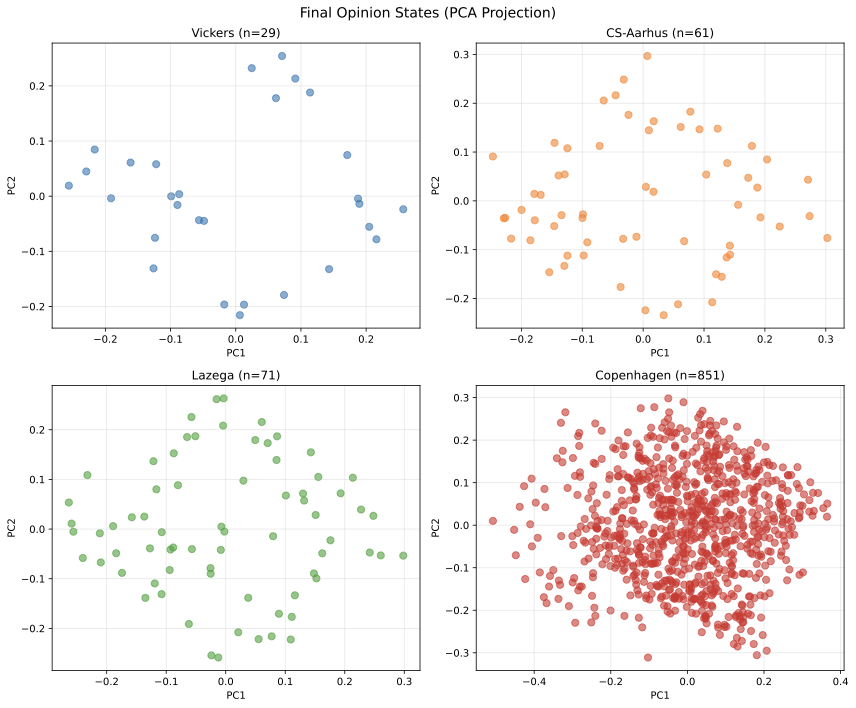
| Vickers | Students | 29 | 250 | 3 | 0.616 |
| CS-Aarhus | University | 61 | 353 | 5 | 0.193 |
| Lazega | Law firm | 71 | 1008 | 3 | 0.406 |
| Copenhagen | DTU study | 851 | 85115 | 4 | 0.235 |
Copenhagen: proximity (Bluetooth), calls, SMS, Facebook, tests scalability to ~800 agents.
Final opinion states
Ablation study
| Hypothesis | Metric | With | Without |
|---|---|---|---|
| Resonance → echo chambers | Trust segregation | 1.15 | 1.00 |
| Personality → trust diversity | Trust variance | 0.0094 | 0.0088 |
| Memory → stability | Volatility reduction | n/a | n/a |
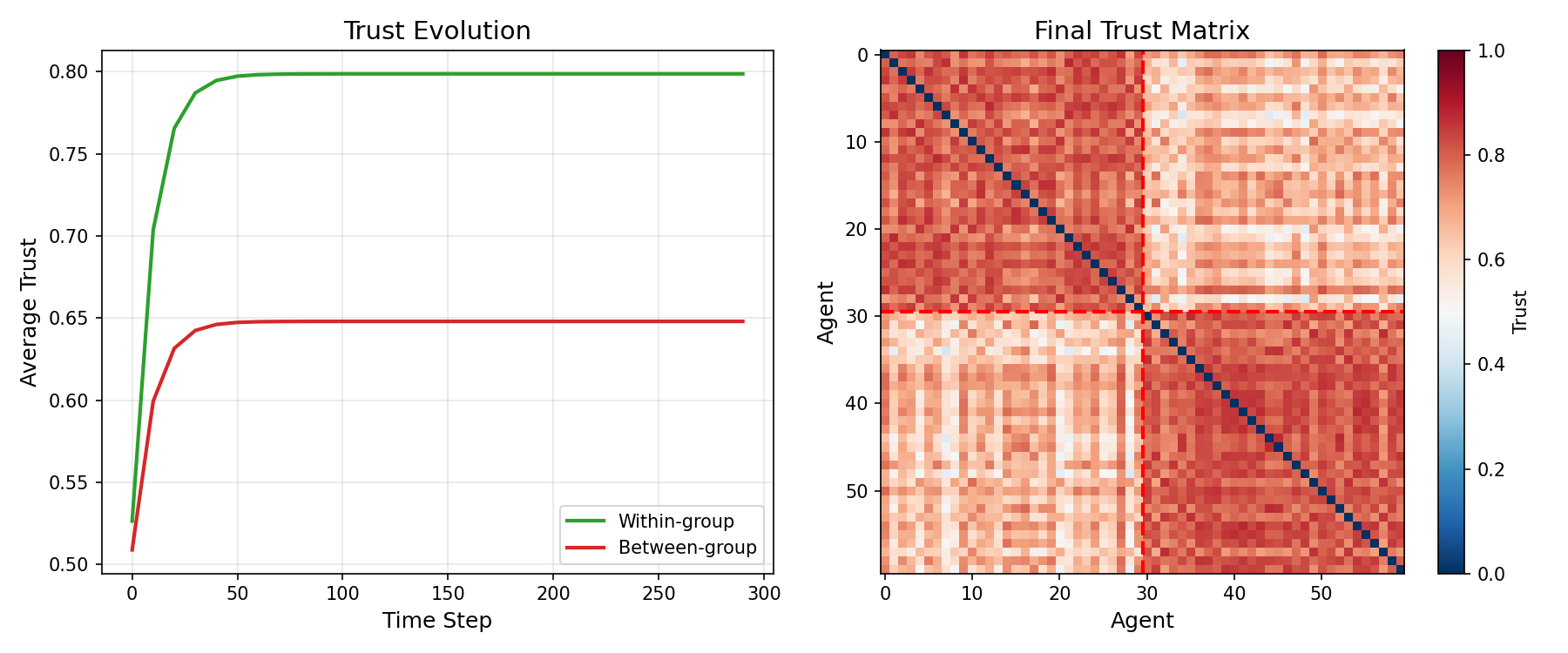
- Resonance is the strongest signal: +14.7% trust segregation between opinion groups.
- Personality: modest \(1.1\times\) trust-variance increase.
- Memory: metric undefined as an initialization artefact, but \(\alpha\) has a formal stabilizing role (Theorem 2).
Bifurcation analysis
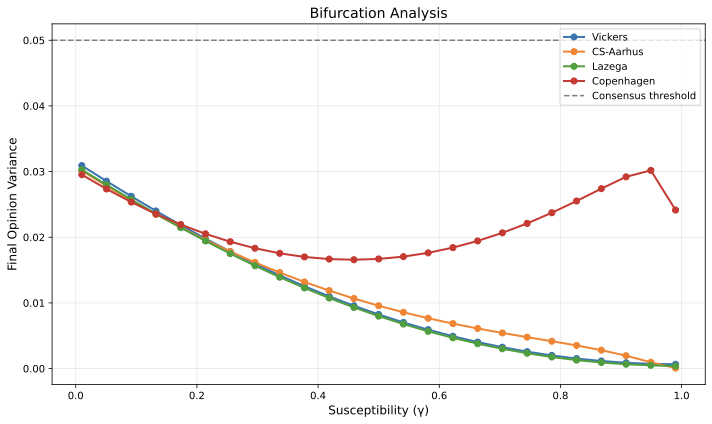
In dense multiplex graphs, \(\lambda\) does not differentiate behaviour, the diagnostic axis is resonance \(\beta\).
Baseline comparison
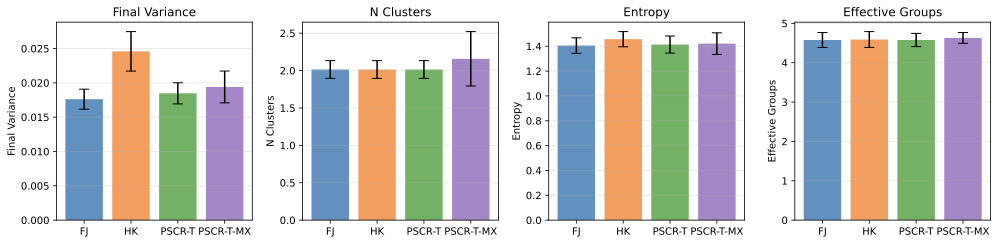
| Metric | FJ | HK | PSCR-T |
|---|---|---|---|
| Final variance | 0.0176 | 0.0246 | 0.0185 |
| Entropy | 1.4056 | 1.4567 | 1.4137 |
PSCR-T occupies a principled middle ground: more spread than globally-coupled FJ, less than threshold-driven HK.
Why the ordering is expected
- FJ: global static weights → persistent averaging → tightest equilibrium (never severs coupling).
- HK: hard threshold cuts neighbourhoods early → locks in most diversity.
- PSCR-T: soft resonance progressively attenuates cross-cluster influence without cutting it.
All three converge to \(\approx 2\) clusters, the macro-partition is driven by network community topology.
Robustness
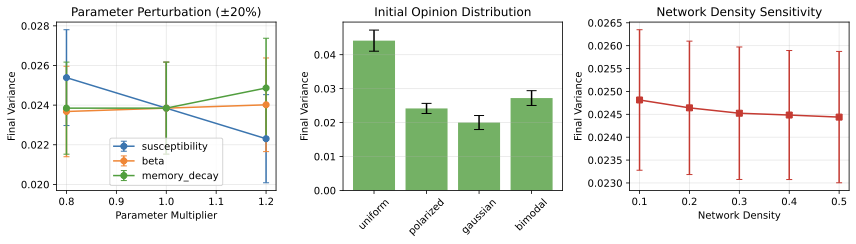
- Susceptibility \(\lambda\) most sensitive (\(\pm 8.4\%\)); \(\beta,\alpha\) below 4%.
- Final variance within 7% across uniform / polarized / Gaussian / bimodal seeds.
Validating the theory
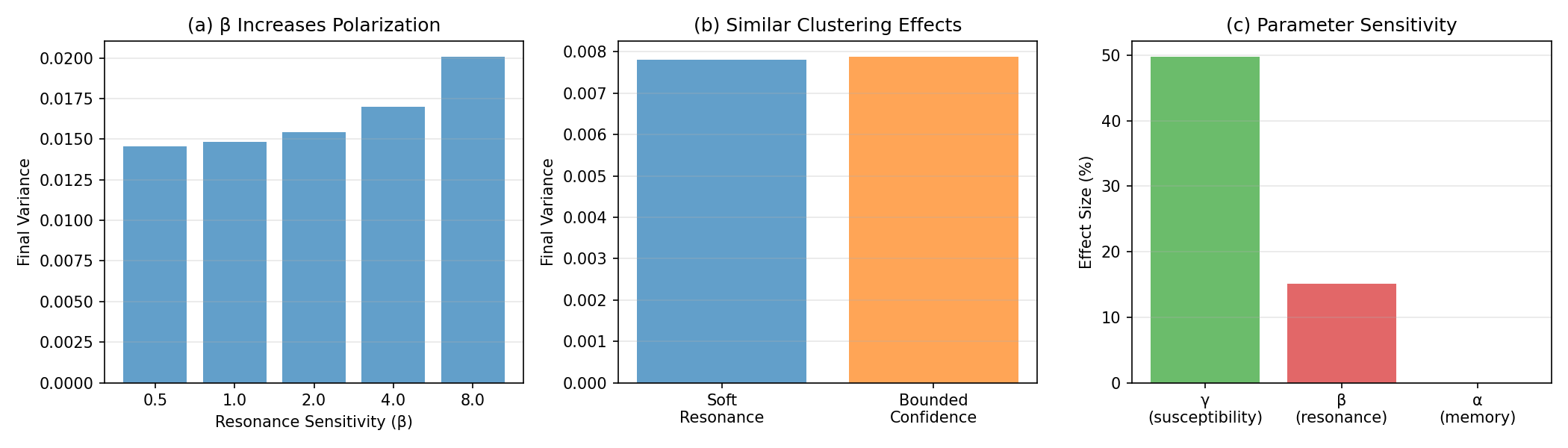
- Resonance drives polarization: variance rises \(\approx 37.5\%\) as \(\beta:0.5\to 8.0\).
- Bounded confidence unnecessary: soft gating matches hard thresholds within <5%.
Trust echo chambers
Part I: takeaways
- PSCR-T integrates salience, resonance, personality-trust and memory on multiplex networks.
- Convergence (Thm 1), small-gain stability (Thm 2), impossibility (Thm 3), attenuation (Thm 4).
- Validated across 29–851 nodes; resonance is the dominant mechanism for segregation.
- Static FJ cannot fragment; PSCR-T achieves effective severance while trust persists.
Part II
Spatial Opinion Models
& Community Detection
The geometry of opinion diversity
From topology to opinion content
A social network that looks like one homogeneous blob almost always decomposes into smaller, opinion-coherent communities.
- Classical detection uses edge topology only.
- People may be tied by social norms (same school) yet hold very different opinions.
- Goal: communities that are structurally connected and opinion coherent.
Representing an opinion
Simplex
Components sum to 1; raising one lowers the others, a trade-off constraint.
\([0,1]\) vector (this work)
Each component independent in \([0,1]\); overlapping strong stances allowed with no trade-off.
The independent-vector choice lets an agent care strongly about many issues at once.
Modularity recap
\[ Q = \frac{1}{2m}\sum_{i,j}\Big[A_{ij}-\frac{k_i k_j}{2m}\Big]\delta(c_i,c_j) \]
- Internal edge density vs. a degree-preserving random (configuration) model.
- Higher \(Q\) = more distinct community structure.
- The objective function for the modified Louvain algorithm developed here.
Two classical algorithms
Girvan–Newman
- Divisive; remove highest edge-betweenness.
- Produces a dendrogram; cut at max \(Q\).
- Expensive: \(O(m^2 n)\).
Louvain
- Phase 1: greedy local \(\Delta Q\) moves.
- Phase 2: aggregate communities into super-nodes.
- Near-linear → millions of nodes.
Also: Leiden (well-connected guarantee), Infomap, stochastic block models, spectral.
Spatial data structures
Minimum Bounding Rectangle
Smallest axis-aligned box enclosing an opinion polygon. Cheap proxy: disjoint MBRs ⇒ no intersection.
R-tree
Height-balanced hierarchical index of MBRs. Prunes disjoint subtrees → sub-linear queries.
These make opinion-overlap queries scale to tens of thousands of users.
Where this sits
Three research streams intersect here:
- Topology-based detection: Girvan–Newman, Louvain, Leiden, Infomap, SBMs, all ignore node content.
- Opinion-driven detection: MJR/IAS, center–base–fringe control, gossip-SBM recovery, none couple geometry + spatial indexing.
- Spatial data structures: R-trees adapted from geographic data to opinion space, where Euclidean proximity \(\approx\) ideological alignment.
Related work: FJ as an intervention substrate
- Musco et al. (2018), Matakos et al. (2017): structural edits that minimise conflict and polarization.
- Chen et al. (2018): the consensus vs. diversity trade-off.
- Abebe et al. (2018), Gionis et al. (2013): opinion maximisation by seeding agents.
- Shin (2014), Zhang (2023), Xing (2023): opinion-aware community work (MJR/IAS, center/base/fringe, gossip-SBM recovery).
None combine geometric multidimensional representation with spatial indexing for reassignment, the gap this chapter fills.
Scalar FJ: the substrate
Weighted network, anchoring weights \(w_{ii}\in(0,1]\), \(w_{ii}+\sum_{j\ne i}w_{ij}=1\):
\[ x_i(t) = \sum_{j\ne i} w_{ij}x_j(t-1) + w_{ii}x_i(0) \;\Rightarrow\; \mathbf{x}^* = (I-A)^{-1}B\,\mathbf{x}(0) \]
\(A\) substochastic (\(\rho(A)<1\)) ⇒ unique stable state; \(\epsilon\)-convergence in \(O(\ln(n/\epsilon))\) steps.
Augmenting the graph with perspectives
Each individual \(v_i\) holds \(p_i\ge 1\) perspectives → add perspective nodes \(v_{i1},\dots,v_{ip_i}\):
\[ V' = V \cup \{v_{ij}\}, \qquad E' = E \cup \{(v_{ij},v_{kl}) : (v_i,v_k)\in E\} \]
Every perspective of \(i\) links to every perspective of each neighbour \(k\). All aspects of a belief influence one another.
Multi-perspective dynamics
Each perspective updates by FJ over neighbours' perspectives:
\[ x_{ij}(t{+}1) = \lambda_{ij}x_{ij}(t) + (1-\lambda_{ij})\!\!\sum_{v_k\in N(v_i)}\sum_{l=1}^{p_k} w_{ij,kl}\,x_{kl}(t) \]
with \(\sum_{k,l} w_{ij,kl}=1\). Weights depend on relationship strength, perspective similarity and \(p_i,p_k\).
From vectors to opinion polygons
Map an \(N\)-dim opinion vector to a regular \(N\)-gon inscribed in the unit circle:
\[ \theta_i = \frac{2\pi(i-1)}{N}, \qquad P_i = (x_i\cos\theta_i,\; x_i\sin\theta_i) \]
- Each axis = one aspect of the subject; vertex position = stance \(x_i\in[0,1]\).
- Connecting vertices traces the agent's opinion profile.
Lifting to 3D polyhedra
Add a \(z\)-coordinate = a user metric (mean opinion, centrality, influence):
\[ z_u = \frac{1}{N}\sum_{i=1}^{N} o_i \]
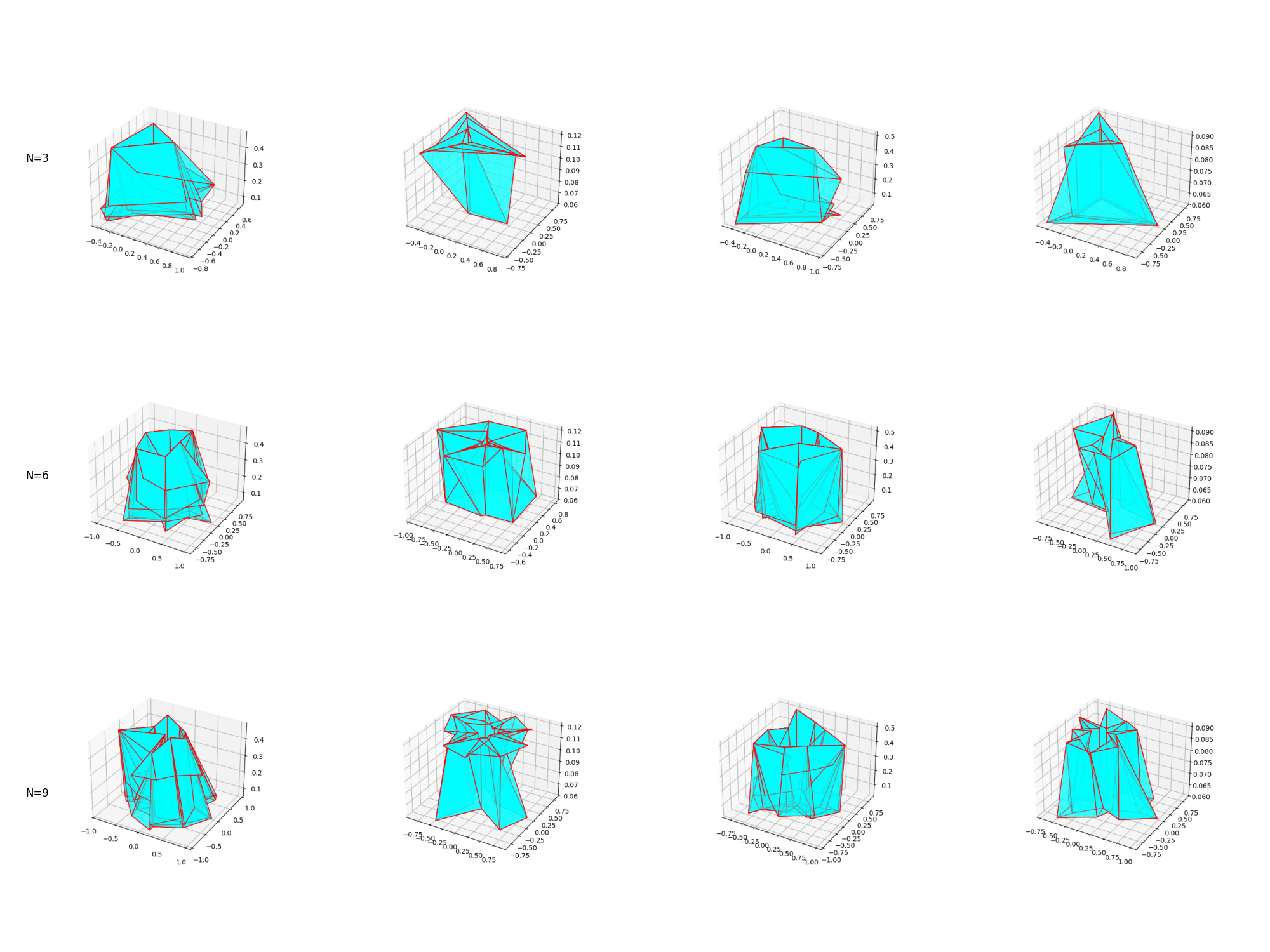
Connecting corresponding vertices across users forms a polyhedron. Volume via tetrahedral decomposition:
\[ V_{\text{tetra}} = \tfrac{1}{6}\big|\det[\,\cdots\,]\big|, \qquad V_{\text{poly}} = \sum V_{\text{tetra}} \]
Reading the volume
- Larger volume → more divergent opinions; smaller → stronger agreement.
- \(z=\) centrality: relates opinion heterogeneity to user importance.
- \(z=\) betweenness: shows diversity among bridge users.
The polyhedron couples opinion spread with network position in one geometric object.
The \(z\)-axis carries meaning
- Mean opinion: pure opinion distribution, large volume = divergence.
- Degree centrality: do influential users hold diverse or cohesive views?
- Betweenness: opinion diversity among the network's bridge users.
Same construction, different \(z\) → different question answered about the same community.
The Opinion Diversity Index
Per community \(k\): a polyhedron volume \(V_k\). Stack into the opinion volume vector \(\mathbf{v}=(V_1,\dots,V_k)\):
Normalised by node count → comparable across networks of different sizes.
Volume bounds
Minimum
All opinions \(=0\) → polygons collapse to origin → volume \(= 0\).
Maximum
All opinions \(=1\) → full regular \(n\)-gons: \( V \approx \tfrac{1}{2}n\sin(\tfrac{2\pi}{n}) \).
Any interior configuration shrinks each inscribed polygon → smaller volume.
Diversity-index experiments
| Dataset | Nodes | Edges | Avg deg | Clustering |
|---|---|---|---|---|
| WOSN 2009 | 63,731 | 817,090 | 25.64 | 0.22 |
| Karate Club | 34 | 78 | 4.59 | 0.571 |
Opinion vectors synthetically augmented (no public ground-truth multidimensional opinions). Volumes via Quickhull (SciPy).
Validity scope: a controlled structural stress test of the geometry, methodological, not calibrated behavioural claims.
Diversity grows with dimensionality
| Dataset | Metric | Dim | Communities | \(D(G)\) |
|---|---|---|---|---|
| Karate | Mean | 3 | 4 | 0.0132 |
| Karate | Mean | 6 | 4 | 0.0324 |
| Karate | Mean | 9 | 4 | 0.0384 |
| WOSN | Mean | 9 | 209 | 1.0e-4 |
| WOSN | Centrality | 9 | 195 | 1.26e-6 |
Mean-opinion \(z\) amplifies divergence; centrality-based \(z\) is lower, influential users hold more cohesive opinions.
Opinion shapes visualised
Opinion-driven community detection
Louvain + MBR overlap + R-tree reassignment
The idea
- Run Louvain for a structural partition (maximise \(Q\)).
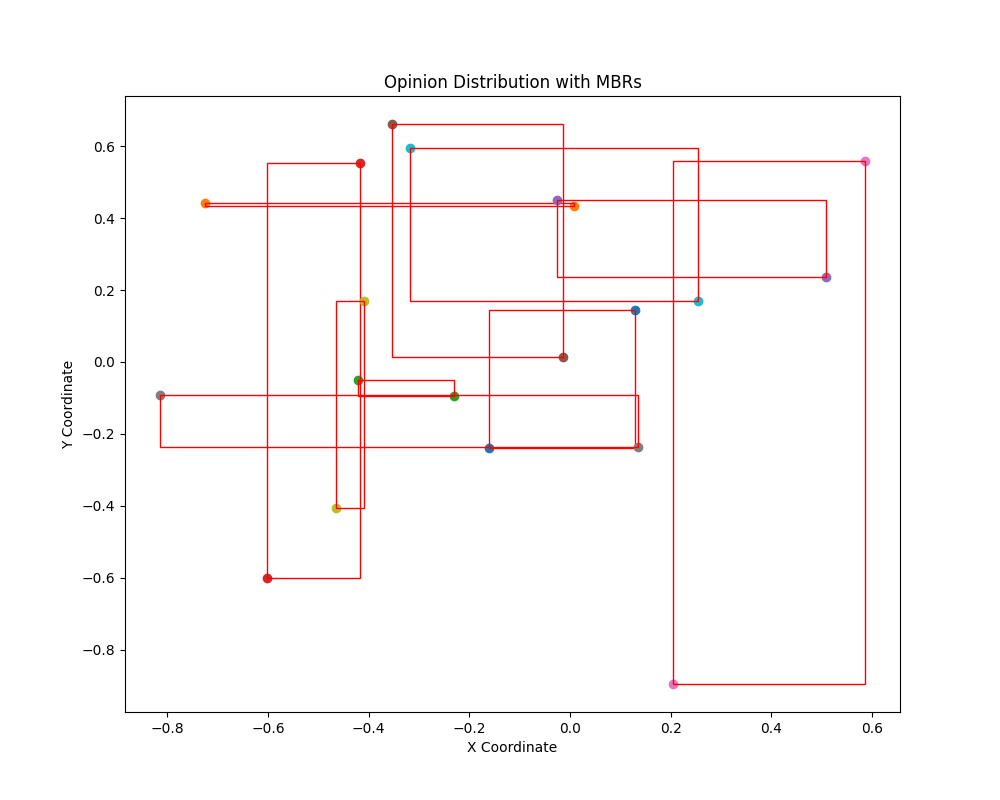
- Encode each node's opinion as an MBR in 2D opinion space.
- Index MBRs in an R-tree; find overlaps efficiently.
- If a node's MBR overlaps several communities → reassign to the nearest opinion centre (Euclidean).
Result: communities that are structurally connected and opinion coherent.
MBR & overlap algorithms
Build MBR
For each opinion \(o_{ij}\): \((x,y)=(o_{ij}\cos\theta_j, o_{ij}\sin\theta_j)\); track min/max → box.
Find overlaps
Recurse the R-tree, pruning children whose MBR is disjoint from the query. \(O(\log n + k)\) per node.
Reference point stored: a point (1D), segment centre (2D), or polygon centre (\(\ge\)3D).
The reassignment rule, in detail
After Louvain gives a structural partition, for each node \(i\):
- Query the R-tree for MBRs overlapping \(\text{MBR}_i\).
- If it overlaps several communities, compute the distance to each opinion reference point: \(d_c=\sqrt{(x_i-x_c)^2+(y_i-y_c)^2}\).
- Reassign \(i\) to the community with the smallest \(d_c\).
- No overlap: keep the original label.
A structural pass (Louvain) followed by an opinion-coherence pass (R-tree), kept polylogarithmic per node.
MBRs in opinion space
Complexity
| Step | Complexity |
|---|---|
| Louvain detection | \(O(I\cdot|E|\cdot\log n)\) |
| R-tree construction | \(O(n\log n)\) |
| Overlap queries | \(O(n(\log n + k))\) |
| Community updates | \(O(n\cdot k)\) |
| Total | \(O(n\log n + n\cdot k)\) |
Preserves Louvain's practical scalability; degrades only when overlaps \(k\) or density explode.
Cohesion & separation
Intra-community agreement (lower = tighter):
\[ O_{\text{coh}} = \tfrac{1}{|\mathcal{C}|}\sum_k\sum_d \mathrm{Var}(\{o_{i,d}: i\in k\}) \]
Inter-community differentiation (higher = distinct):
\[ O_{\text{sep}} = \tfrac{1}{|\mathcal{C}|^2}\sum_{k_1,k_2}\|c_{k_1}-c_{k_2}\| \]
Two lenses on opinion structure inside and across communities.
Detection results: Karate
| Dataset | D | Algorithm | Modularity | Cohesion | Separation |
|---|---|---|---|---|---|
| Karate | 5 | Modified | 0.4198 | 13.28 | 0.1623 |
| Karate | 5 | Original | 0.4151 | 12.97 | 0.1729 |
| Karate | 15 | Modified | 0.3920 | 42.64 | 0.0699 |
| Karate | 15 | Original | 0.4151 | 42.19 | 0.0723 |
Modified Louvain keeps structural connectivity while improving opinion cohesion/separation, advantage grows with dimensionality.
Detection results: Random (Watts–Strogatz)
| Dataset | D | Algorithm | Modularity | Cluster coeff. | Cohesion |
|---|---|---|---|---|---|
| Random | 2 | Modified | 0.4188 | 0.5533 | 7.20 |
| Random | 2 | Original | 0.3949 | 0.5244 | 5.19 |
| Random | 15 | Modified | 0.4188 | 0.5533 | 45.22 |
| Random | 15 | Original | 0.4198 | 0.5502 | 45.06 |
Structural metrics (modularity, clustering) stay consistent; opinion cohesion strengthens as dimensionality rises.
Community reassignment visualised
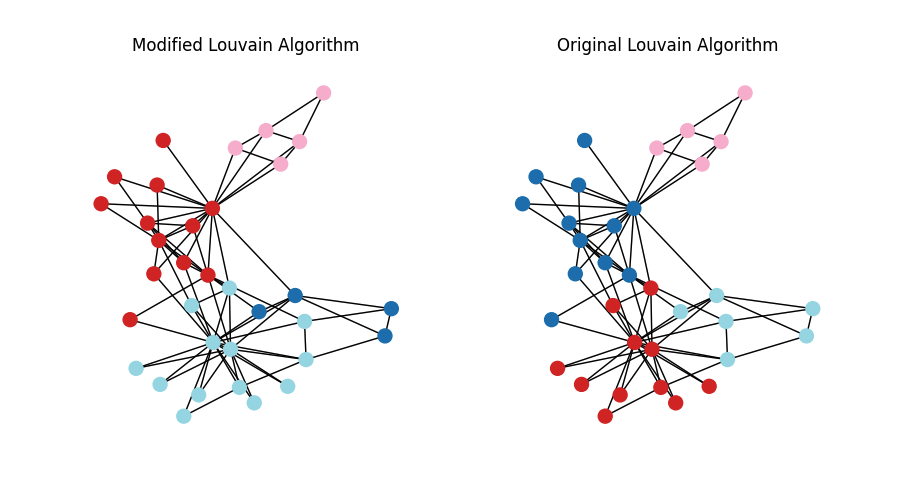
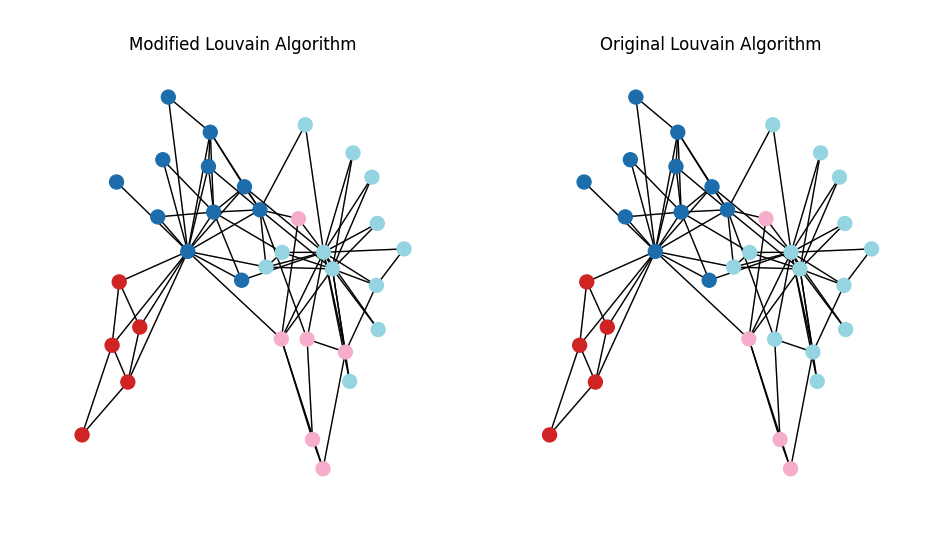
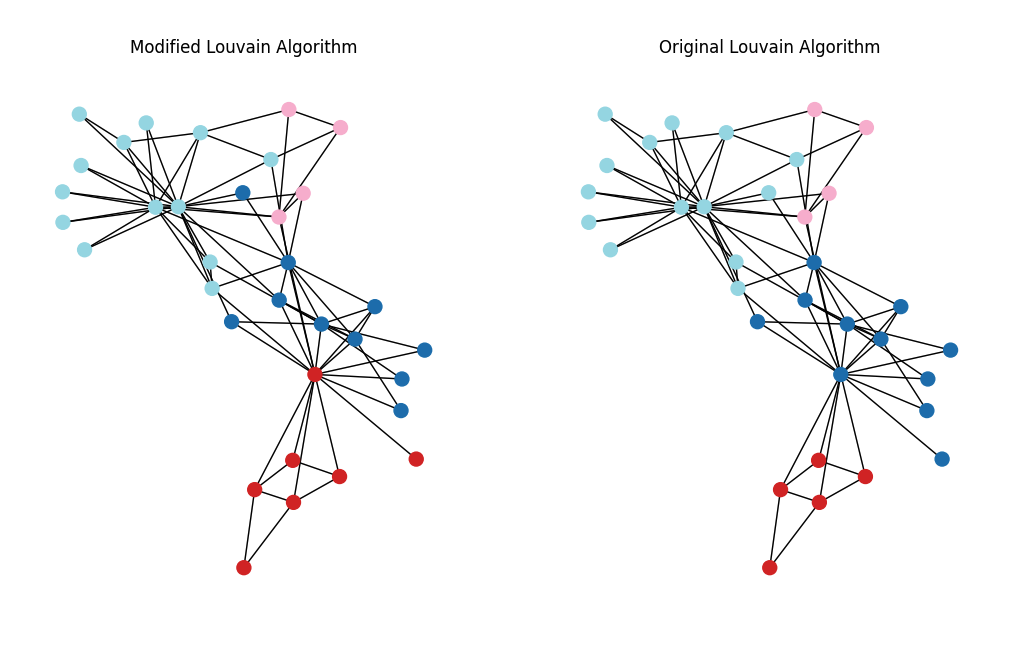
Same node positions; colours change as opinion-space overlap moves nodes between communities.
Part II: takeaways
- Opinion polygons → 3D polyhedra give a geometric measure of diversity, \(D(G)\).
- Diversity index grows consistently with opinion dimensionality.
- MBR + R-tree let Louvain incorporate opinion overlap at \(O(n\log n + nk)\).
- Communities become structurally connected and ideologically coherent.
Part III
Detecting Opinion
Diversity Collapse
D-CEWS: a detrended causal early-warning system & a gated intervention
An unresolved risk
Coherence and consensus are two sides of the same coin.
- An RL narrative-graph optimizer converges to high-coherence representations of discourse.
- A reward that favours agreement can, in principle, drive the real population toward consensus, silently erasing the diversity that Part II measures.
- None of the earlier frameworks measures or acts on this risk directly.
Testing it needs two ingredients:
- A population whose opinion can genuinely collapse: the noisy voter model.
- A way to intervene before it does: a causal early-warning detector + gated policy.
Narrative graphs × noisy voter model
- SVO triplets (spaCy) → directed narrative graph per discourse cluster \(k\).
- Each node \(i\) of a real network holds \(s_i\in\{0,1\}\) and flips with probability
- \(f_i\): fraction of neighbours in the opposite state · \(a_k\): noise rate · \(h_k\): herding rate.
- Independent Bernoulli randomness ⇒ collapse is a stochastic event with timing variance.
Tying the reward to conformity
Rates are driven by the narrative reward's own weights \((\lambda_1,\lambda_3)\):
\[ h_k \leftarrow \max\big(0,(1-\rho)[h_k+\eta_r\lambda_1]\big),\qquad a_k \leftarrow \max\big(0,(1-\rho)[a_k+\eta_d\lambda_3]\big) \]- Coherence-heavy reward → more conformity pressure; diversity-aware reward → more tolerance.
- Diversity signal: Shannon entropy \(H_k(t) = -p\log_2 p-(1-p)\log_2(1-p)\), minimal at consensus, maximal at \(p=0.5\).
- Complements \(D(G)\): the index can rise during collapse, dominated by the largest surviving community.
D-CEWS: the detector
- Trailing window of \(W\) steps; remove a linear trend (least squares).
- Compute lag-1 autocorrelation and variance of the residuals (critical slowing down).
- Standardize causally, using only values strictly before step \(t\):
- Rolling Kendall-\(\tau\) trend test on the risk: enter
dangerabove an upper threshold, clear below a lower one.
Three intervention policies
| Policy | Behaviour once D-CEWS fires |
|---|---|
| Toggling | Diversity weights while danger, revert to baseline otherwise |
| Gated latching | Switch to diversity weights permanently for the rest of the run |
| Proportional | Diversity weight scales continuously with the entropy deficit (optional D-CEWS term) |
Experimental setup
- Networks: political-blogosphere subgraph (Adamic & Glance 2005) and Zachary's Karate Club (control).
- Narrative content: 26 congressional statements across three discourse clusters.
- Herding/noise calibrated on the unforced dynamics to locate a genuine transition region.
- 48 seeds per condition & network; collapse = entropy below threshold for ≥ 20 consecutive steps.
A representative collapse
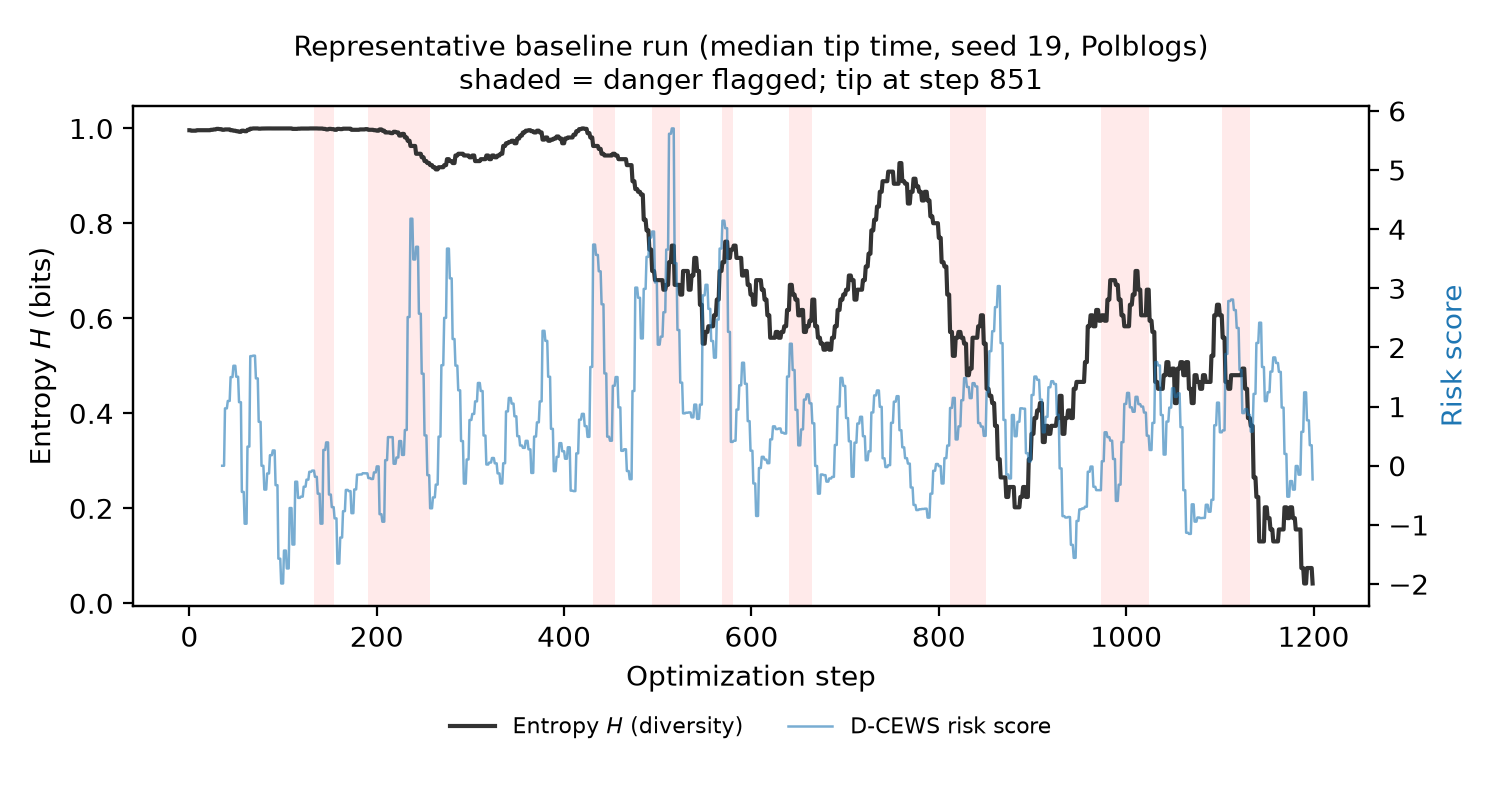
danger) crosses the trigger repeatedly before collapse.Collapse rates by condition
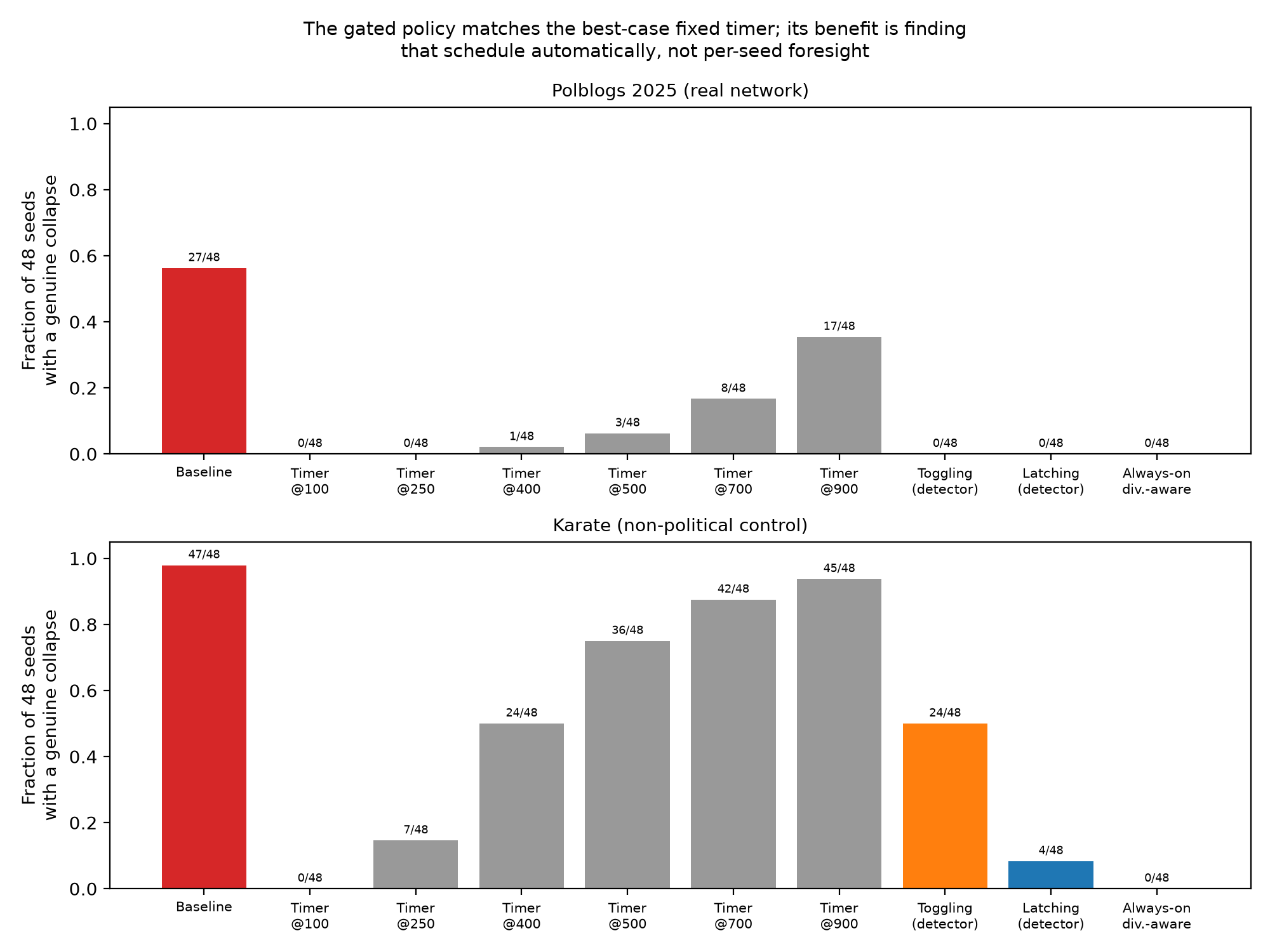
- Coherence-only baseline: collapse in the majority of seeds (polblogs), nearly all (Karate).
- Always-on diversity reward fully prevents collapse; gated latching leaves only a small residual (Fisher's exact test, highly significant).
- Toggling, with the identical detector, is markedly weaker on Karate: pressure resumes between interruptions.
Simple switch vs. continuous control
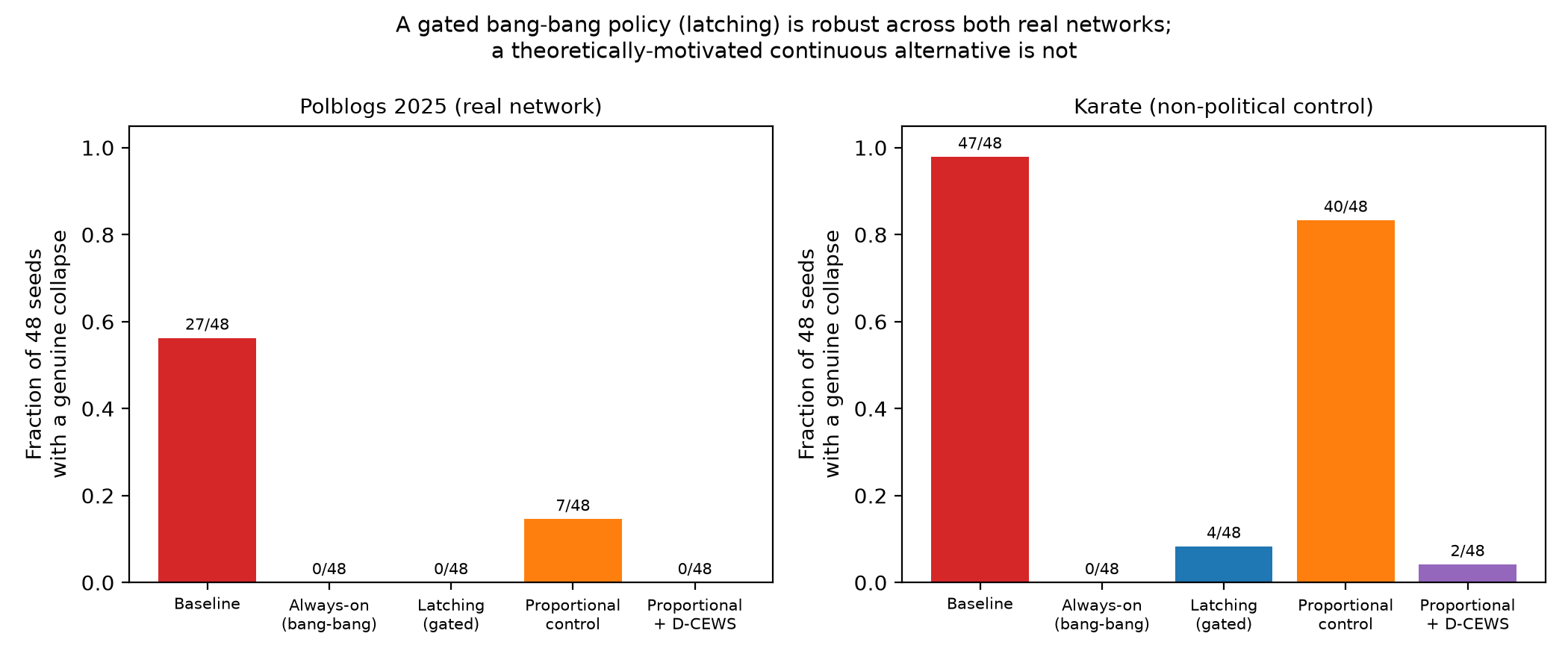
- Plain proportional control left Karate almost as exposed as the baseline.
- With a D-CEWS boost it matched the gated policy only inconsistently.
- Gated latching was the only condition robust on both networks, consistent with bang-bang & hysteresis results.
What the detector is (and is not)
- The risk score predicts the collapse run-up significantly above chance on both networks.
- Not uniformly the single best candidate statistic.
- Per-seed correlation of danger onset vs. collapse time: not significant.
Its value lies in firing early and reliably enough, on average, for a sustained response to work, not in forecasting any individual run.
Echoes Part I: static, always-on mechanisms cannot achieve dynamic protection; an explicit, state-dependent gate is required.
Part III: takeaways
- An unregularized coherence reward can drive genuine, noise-induced consensus collapse.
- D-CEWS: detrended, causal AR1 + variance risk with a Kendall-\(\tau\) trigger.
- A switch that trips once and stays on prevents collapse on both real networks.
- Sustained response, not continuous fine-tuning, closes the polarization-risk gap.
Part IV
The Social-Media Discourse Context
Complementary published work, the environment opinion dynamics live in
Why context matters
Online influence is mediated through language carrying framing, emotion, and strategic ambiguity.
- These works are treated as an exogenous layer that shapes salience & initial conditions.
- They clarify why psychologically grounded mechanisms are needed, not new state variables.
Two are closest to social dynamics (discord, narrative); two set boundary conditions (irony, ethics).
From disagreement to discord
Online fragmentation is often not about missing exposure, but the quality of interaction after exposure.
- Disagreement = weighted pairwise opinion distance; discord = deterioration of relational conditions.
- A network can stay topologically connected while becoming communicatively brittle.
- Internal vs. external conflict, amplified by visibility, performativity, rapid feedback.
- Polarization alone is an incomplete health metric: discord can rise while polarization looks stable.
Narrative coherence via SVO graphs + RL
- Extract subject–verb–object triplets → dynamic narrative graphs (entities = nodes, relations = edges).
- Coherence as a graph property: \( \mathcal{C}(G) = \dfrac{T\cdot\sigma_{SW}}{C\cdot n} \) (triangles, small-world, clustering, size).
- Reinforcement learning maintains coherence under evolving input streams.
- Party messaging shows distinct structural signatures, connectivity, not just sentiment.
A contextual signal generator for opinion dynamics: which dimensions become salient, which relations credible. Its collapse risk is the subject of Part III.
Boundary conditions: irony & ethics
Irony & sarcasm
- Literal text can invert intended meaning → sentiment \(\ne\) opinion distance.
- Shift from rule-based to transformer methods; robustness still limited.
- Motivates conservative inference when mapping text to opinions.
Ethical LLM analysis
- Capability vs. transparency vs. auditability trade-off across model families.
- AI-assisted interpretation is never model-neutral.
- Guardrails: audit trails, no single-model dependence, separate model from social uncertainty.
Publications
| Paper | Venue | Feeds |
|---|---|---|
| Cognitive Resonance & Trust Dynamics in Multidimensional Opinion Formation on Multiplex Networks | IEEE Trans. Cognitive & Developmental Systems (in review, Q1) | Part I |
| Beyond Binary Opinions: Quantifying Opinion Diversity in Communities | SNAMS 2024 | Part II |
| Spatial Opinion-Driven Community Detection in Social Networks | IEEE AICSIP 2025 | Part II |
| Detecting Opinion Diversity Collapse: An Early-Warning System for Narrative Graphs | SNAMS 2026 (accepted) | Part III |
| Adaptive Narrative Coherence Modeling via Graph Embeddings & RL | SNAMS 2025 | Part IV |
| From Disagreement to Discord | IEEE IT Professional 2025 (Q2) | Part IV |
| Comparative Review of Deep Learning for Irony & Sarcasm | IEEE Trans. AI 2025 (Q1) | Part IV |
| Ethical Analysis of LLMs: GPT, DeepSeek, Claude, Gemini, LLaMA, Qwen | IEEE ISTAS 2025 | Part IV |
Total citations: 31. Together they ground the theory in real social-media environments.
Conclusions
Synthesis · limitations · future work
The core thesis
The gap between scalar models and human belief is not one of parameterisation, it is one of fundamental structure.
- Opinions live in a multidimensional space.
- They are filtered through psychologically real mechanisms.
- They flow through networks that are themselves shaped by opinion proximity.
No single scalar can capture all of this.
Contributions: PSCR-T
- Salience-weighted distance, sigmoid resonance gate, memory-weighted personality trust.
- Global convergence + small-gain local stability with an explicit network-aware bound.
- Impossibility theorem for static FJ; constructive attenuation \(W_{ij}^{\text{eff}}\le e^{-\beta D_{\min}^2}\).
- Validated on four multiplex networks; resonance → +14.7% trust segregation; \(\beta\) → +37.5% variance.
Contributions: geometry & communities
- Opinion polygons → polyhedra; the Opinion Diversity Index \(D(G)=\|\mathbf{v}\|_2/|V|\).
- Index grows with dimensionality (Karate: 0.0132 → 0.0384 from 3D to 9D).
- Modified Louvain via MBR + R-tree at \(O(I|E|\log n)\).
- Communities structurally connected and ideologically coherent, advantage grows with dimension.
Contributions: diversity collapse
- Narrative-coherence RL coupled to the noisy voter model: an unregularized coherence reward causes genuine stochastic consensus collapse.
- D-CEWS: a causal, detrended early-warning detector built on critical slowing down.
- Gated latching prevents collapse robustly on two real networks; toggling does not, and continuous control does not improve on it.
- Completes the arc: how to represent, measure, and protect multidimensional opinion diversity.
Limitations
- Calibration: \(\beta,\alpha,\) salience not fitted to longitudinal panel data → structural, not forecast, claims.
- Synthetic opinions: uniform seeds miss real correlated low-dimensional manifolds.
- Static structure: topology fixed, no full opinion–network co-evolution.
- Scalability of 3D polyhedra for very large, high-dimensional communities.
- Language/platform specificity of the NLP components (mostly English/X).
Future work
- Longitudinal calibration of PSCR-T (ANES, ESS panels) via Bayesian / simulation-based inference.
- Continuous-time Laplacian coupling \(\dot{\mathbf{o}}_i=-L(\mathbf{A}(t))\mathbf{o}_i+\lambda_i(\mathbf{b}_i-\mathbf{o}_i)\).
- Co-evolutionary topology + opinion dynamics with joint convergence proofs.
- Polarization-mitigation interventions as optimization on the resonance dynamics.
- Manifold learning diversity (UMAP, diffusion maps) beyond the 3D projection.
- LLM-derived opinion embeddings → end-to-end text-to-dynamics pipeline (with ethical guardrails).
Closing
A theoretically grounded, empirically tested foundation from which a richer science of collective opinion can be built.
Echo chambers, misinformation, resilient polarization remain pressing. Treating opinion as the multidimensional, psychologically grounded, structurally embedded quantity it truly is offers one principled path toward understanding, and mitigating, these dynamics at scale.
Thank you
Questions?